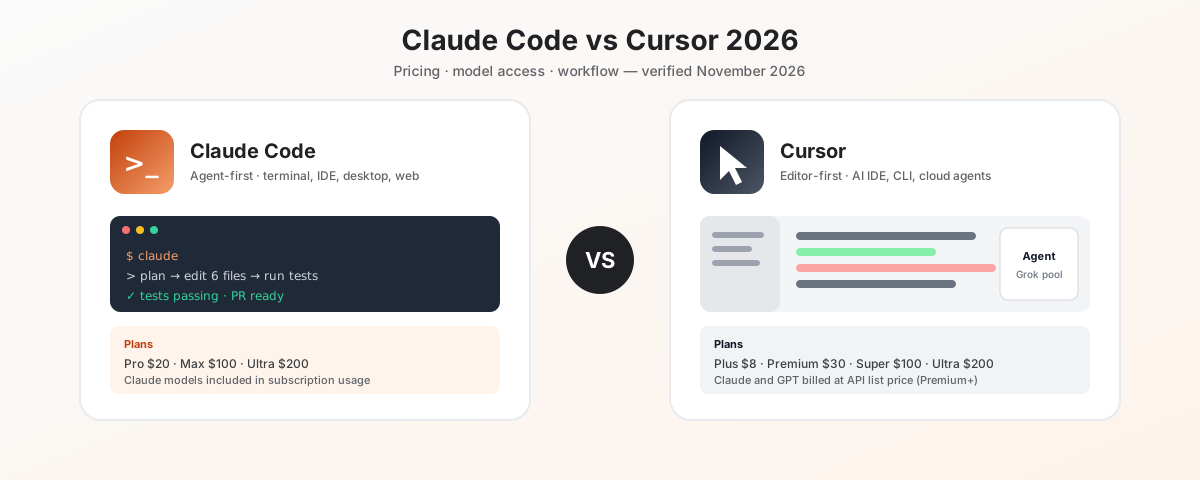
Short answer: As of November 2026, choose Claude Code if Claude models are your main tool. Claude Code usage comes with every paid Claude plan from $20/month, and it runs in your terminal, VS Code, JetBrains, a desktop app, and the browser. Choose Cursor if you want an AI-native editor and you’re fine working mostly with Grok and Cursor’s own Composer models. Cursor’s paid plans now run from $8 to $200/month, and Claude and GPT models are billed separately at API list price, outside the plan’s usage pool.
The second point is new, and it’s why this comparison matters more now than it did a few months ago. Cursor announced on August 14, 2026 that SpaceX had acquired it. Its pricing has since been rebuilt around Grok and X subscriptions. If you picked Cursor mainly to use Claude inside a polished editor, the math has changed.
Claude Code vs Cursor at a glance
| Area | Claude Code | Cursor |
|---|---|---|
| What it is | Agentic coding tool from Anthropic | AI-first code editor (VS Code-based), plus CLI and cloud agents |
| Where it runs | Terminal, VS Code, JetBrains, desktop app, web, mobile | Cursor editor, Cursor CLI (agent), cloud agents |
| Entry paid plan | Claude Pro — $20/mo ($17/mo billed annually) | Plus — $8/mo (Grok models only) |
| Mid tier | Max — $100/mo (5x Pro usage) | Premium — $30/mo (4x Plus) or Super — $100/mo (15x Plus) |
| Top individual tier | Ultra — $200/mo (10x Pro weekly usage) | Ultra — $200/mo (50x Plus) |
| Models included in plan usage | Claude models (Opus, Sonnet, Haiku) | Grok models and Cursor’s Composer models |
| Claude models | Included in subscription usage | Premium tier and up only, billed at API list price |
| Free tier for coding | No — Claude Code isn’t in the Free plan | Yes — limited agent requests |
| Team pricing | $20–$25 per standard seat; $100–$125 per premium seat | $30, $100, or $200 per seat |
Prices as of November 2026, from the official Claude and Cursor pricing pages listed under Sources. Taxes not included.
Pricing compared
Claude Code pricing
Claude Code doesn’t have its own price. It’s included in Claude’s paid subscription plans. Anthropic’s pricing page lists:
- Free — $0. Chat only. The plan comparison lists Claude Code as “No.”
- Pro — $20/month, or $17/month on annual billing ($200 billed up front). Includes Claude Code.
- Max — $100/month. 5x Pro usage every 5 hours and every week, priority access at high-traffic times, and $100/month in API credits for the Claude Platform.
- Ultra — $200/month. 10x Pro usage every week, no 5-hour limit for verified accounts, and $200/month in API credits.
- Team — 2 to 150 seats. Standard seats are $20/seat/month billed annually ($25 monthly). Premium seats get 5x the usage of a standard seat and cost $100/seat/month billed annually ($125 monthly). Both include Claude Code.
- Enterprise. $20/seat/month billed annually with a 20-seat minimum, plus usage billed at API rates.
You can also run Claude Code with an Anthropic Console API key, which bills per token, or through supported third-party cloud providers in the CLI, VS Code, and JetBrains. For a full plan breakdown, see our Claude pricing guide.
Cursor pricing
Cursor’s pricing page and models documentation list:
- Free — $0. Limited agent and Chat requests.
- Plus — $8/month ($80/year). A shared usage pool across Cursor and Grok. The page notes “Only Grok models are available on this plan.”
- Premium — $30/month ($300/year). 4x Plus usage, cloud agents and automations, code hosting via Origin, AI code reviews via Bugbot, and third-party models at API list price.
- Super — $100/month ($1,000/year). 15x Plus usage and priority model access at peak times.
- Ultra — $200/month ($2,000/year). 50x Plus usage and earliest access to new products and models.
- Teams — $30, $100, or $200 per seat, matching Premium, Super, or Ultra. You can mix seat tiers. Third-party models cost API list price plus a Cursor Token Rate of $0.25 per million tokens on eligible models.
- Enterprise — custom, with pooled usage.
Cursor’s usage allowance refreshes weekly. The pool covers Grok and Cursor’s own models. Cursor’s models docs list Grok 4.7, Grok 4.6, Grok 4.5, and Composer 2.5 as included. Third-party models, Claude and GPT among them, are billed from prepaid credit at API list price. The Cursor docs list Claude Sonnet 5.5 at $2 input / $10 output per million tokens and Claude Opus 5.5 at $4 / $20. Our older Cursor pricing breakdown covers the plan lineup Cursor had before this change.
What this means for your bill
There are no published, like-for-like “requests per dollar” figures for either product. Both describe usage as multiples of a base plan. That means you can’t compare them precisely. The structural difference is still clear, though:
- On Claude Code, Claude usage is part of the flat subscription, up to the plan’s 5-hour and weekly limits.
- On Cursor, the flat subscription buys Grok and Composer usage. Every Claude or GPT token is extra, billed at API rates, and only available from the $30 Premium tier up.
If you mostly want Claude models, Claude Code is the more predictable spend. If Grok or Composer handles most of your work and you only switch to Claude now and then, Cursor Premium plus occasional API-priced usage can work out cheaper.
Model access
This is now the biggest difference between the two.
Claude Code runs on Anthropic’s Claude models. The paid plans include Opus, Sonnet, and Haiku. Context windows go up to 1M tokens, depending on the model, per the Claude pricing page. You don’t get GPT or Grok inside Claude Code.
Cursor used to be the easy way to switch between Claude, GPT, and Gemini in one editor. It still offers third-party models on Premium and above, and its docs list current Claude, GPT, and Gemini models with per-token prices. But since the SpaceX acquisition, the included pool is built around Grok and Composer. The two cheapest paid options, Free and Plus, don’t offer third-party models at all.
If you used Cursor mainly to get Claude at a flat price, that option has moved behind API billing. If you liked Cursor for switching models freely, you can still do that from Premium up, but you’ll pay per token for anything outside Grok and Composer.
Workflow and interface
Cursor is an editor first. You get a VS Code-style IDE with AI built into editing, chat, and agent mode. Cursor also has a terminal CLI, started with agent, with Agent, Plan, and Ask modes, a print mode (-p) for scripts and CI, and the option to hand a task off to a cloud agent by starting the message with &. Developers who like seeing every change in an editor tend to prefer Cursor.
Claude Code is an agent first. It started in the terminal, and Anthropic’s docs now list several surfaces: the CLI, a VS Code extension, a JetBrains plugin, a desktop app, Claude Code on the web, and the Claude mobile apps. All of them run the same engine, so your CLAUDE.md, settings, and MCP servers carry over between surfaces. The VS Code extension also installs in Cursor. You can run Claude Code inside the Cursor editor, which is why many developers end up using both.
Claude Code also follows Unix conventions. You can pipe logs into claude -p, run it in CI, or chain it with other command-line tools.
Agents, automation, and customization
Both products have moved well beyond autocomplete.
| Capability | Claude Code | Cursor |
|---|---|---|
| Multi-file agent edits | Yes | Yes (Agent mode) |
| Plan before acting | Yes (plan review in IDE extension) | Yes (Plan mode) |
| Parallel / sub-agents | Sub-agents and background agents | Cloud agents (Premium+) |
| Scheduled / recurring tasks | Cloud and desktop scheduled tasks, /loop | Automations (Premium+) |
| Project instructions | CLAUDE.md, also reads AGENTS.md | Rules, team marketplace for rules/skills/plugins (Teams) |
| Hooks and skills | Yes | Skills and plugins via team marketplace (Teams) |
| MCP support | Yes | Yes (MCP access controls on Enterprise) |
| Code review | GitHub Actions, GitLab CI/CD, GitHub Code Review | Bugbot (Premium+) |
| SDK for custom agents | Claude Agent SDK | Grok API access (Plus+) |
In Claude Code, power-user features like hooks, skills, sub-agents, and scheduled tasks come with every paid plan. In Cursor, cloud agents, automations, and Bugbot start at the $30 Premium tier.
Team plans
For a team of ten, the published seat prices are:
- Claude Team: Standard seats at $20–$25 each, so $200–$250/month for ten. Premium seats with 5x usage cost $100–$125 each.
- Cursor Teams: The cheapest seat is $30, so $300/month for ten, plus API-priced usage and the $0.25/M Cursor Token Rate for third-party models.
Claude’s Team plan also includes the rest of Claude (chat, Claude Design, Docs, and more). That helps if non-engineers on the team will use it too. Cursor Teams adds SAML/OIDC SSO, usage analytics, team-wide privacy settings, and a team marketplace for internal rules and plugins.
Who should choose which
Choose Claude Code if:
- Claude models are your main tool, and you want their usage covered by a flat subscription.
- You work in the terminal, JetBrains, or several editors, and want one agent across all of them.
- You want hooks, sub-agents, CI integration, and scheduled tasks without a higher tier.
- You already pay for Claude Pro or Max for chat.
Choose Cursor if:
- You want a dedicated AI editor and prefer reviewing changes in the editor.
- Grok and Composer are good enough for most of your work, and the $8 Plus or $30 Premium tier fits your budget.
- You want cloud agents, Bugbot reviews, and Origin code hosting in one product.
- You need to switch between Claude, GPT, and Gemini, and accept API-priced billing for them.
Use both if: you like Cursor’s editor but want Claude doing the agent work. Install the Claude Code extension in Cursor and keep Cursor on a lower tier.
Comparing other options too? See Cursor vs GitHub Copilot, Cursor vs Windsurf, and our full list of Cursor alternatives. For the broader stack, see best developer tools.
FAQ
Is Claude Code better than Cursor?
It depends on how you work. Claude Code suits developers who want Claude models with subscription-included usage and an agent that runs in the terminal, IDEs, desktop, and web. Cursor suits developers who want an AI-native editor and are comfortable using Grok and Composer models for most tasks.
Is Claude Code free?
No. Anthropic’s pricing page lists Claude Code as not included in the Free plan. It’s included in Pro ($20/month, or $17/month billed annually), Max ($100/month), Ultra ($200/month), Team, and Enterprise. You can also use it with a pay-per-token Anthropic Console API key.
Can I still use Claude models in Cursor?
Yes, on Premium ($30/month) and higher plans. Third-party models, Claude included, are billed at API list price from prepaid credit and aren’t part of the weekly usage pool. The Free and Plus plans only offer Grok and Cursor’s own models.
Can I use Claude Code inside Cursor?
Yes. Anthropic’s docs offer a direct install link for the Claude Code extension in Cursor, since Cursor is built on VS Code. You get Claude Code’s agent in a Cursor panel, billed through your Claude plan.
Who owns Cursor now?
Cursor announced on its blog on August 14, 2026 that it had been acquired by SpaceX. Its plans now share a usage pool with Grok, and the pricing page lists X features such as posting and a premium checkmark alongside the coding features.
Which is cheaper, Claude Code or Cursor?
Cursor’s entry paid plan ($8/month) is cheaper than Claude Pro ($20/month), but it only includes Grok models. If you mainly want Claude models, Claude Code is usually the more predictable cost, because Cursor charges API list price for every Claude token.
Verdict
There’s no single winner. Since Cursor’s repricing, the choice mostly comes down to which models you want. Claude Code is the better fit if you want Claude: the usage is in the subscription, it works across terminal, IDE, desktop, and web, and its automation features don’t need a higher tier. Cursor is still a polished AI editor and a strong pick if Grok and Composer handle your daily work, or if you want cloud agents, Bugbot, and Origin in one place. If you like Cursor’s editor and Claude’s agent, the Claude Code extension runs inside Cursor.
No ratings or rankings on this page come from hands-on benchmarks. The recommendations are editorial judgments based on the published pricing, plan limits, and documented features listed below.
Sources
- Claude plans and pricing — https://claude.com/pricing
- Claude Max and Ultra plans — https://claude.com/pricing/max
- Claude Code overview (Anthropic docs) — https://code.claude.com/docs/en/overview
- Cursor pricing — https://cursor.com/pricing
- Cursor models and pricing docs — https://cursor.com/docs/models
- Cursor CLI docs — https://cursor.com/docs/cli/overview
- Cursor blog, “Joining SpaceX” (August 14, 2026) — https://cursor.com/blog/joining-spacex
Prices and features verified November 15, 2026.